
Colosseum / Chapter 01
Livia Drusilla
Was the wife of Rome’s first emperor the most scheming octagenarian in the empire, or the most slandered?
15 min read
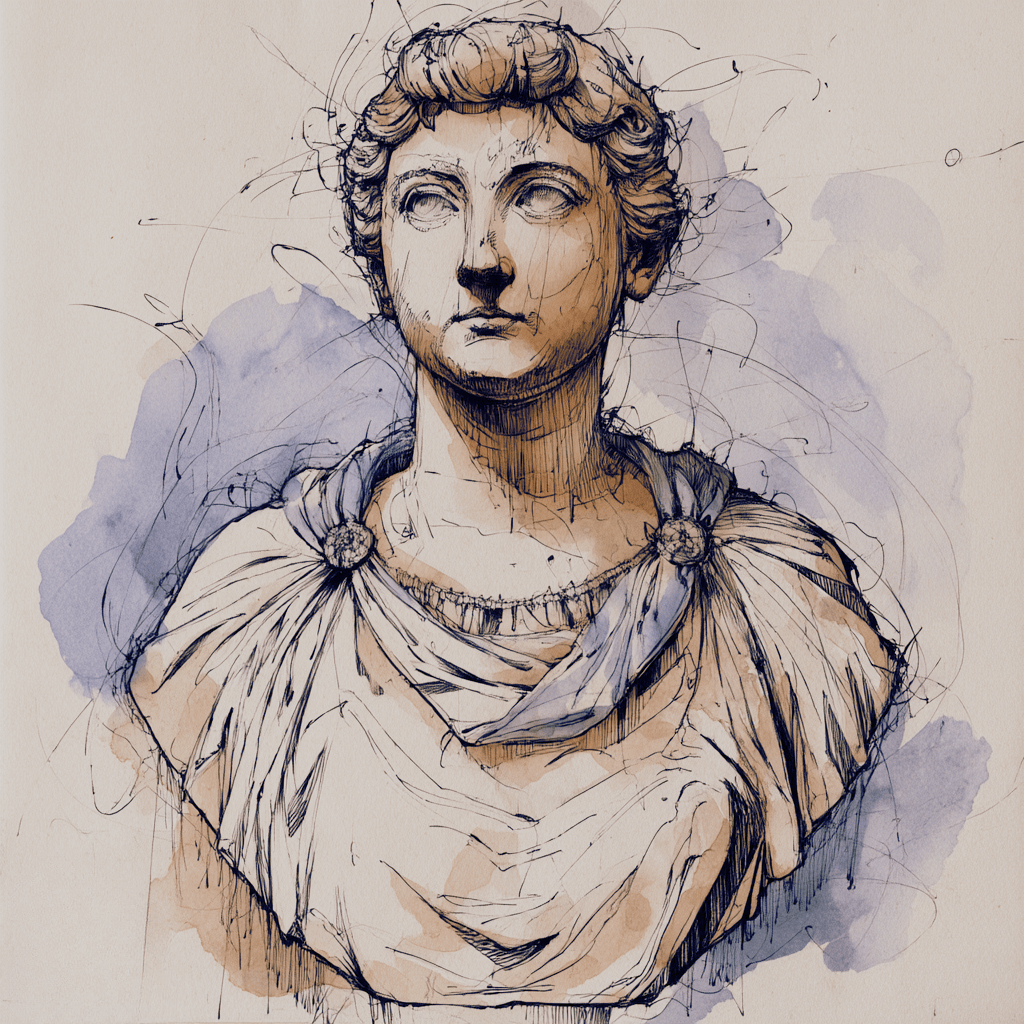
By the time emperor Augustus died, nearly every man the emperor had positioned to take the title was gone, except for Livia’s son Tiberius. Ancient historians as well as more modern fiction writers knew exactly whom to blame for his clear path to leadership. The evidence is another matter.
Livia Drusilla
Livia was born in 58 BCE into one of Rome’s oldest aristocratic families, arriving just as the dying Republic was fracturing into civil war.
Her first marriage was a traditional political match that tied her to the old nobility. Her husband, Tiberius Claudius Nero, was a man who consistently chose the losing side of Rome’s shifting political landscape. But Gaius Octavian, the man who would eventually become Augustus, was smitten with Livia. He arranged for his own divorce (the very day his only biological child, Julia, was born) as well as hers.
In 38 BCE, Livia married Octavian. Accounts claim it was all done with Livia’s husband’s cooperation; Tiberius Claudius Nero reportedly even gave Livia away at the wedding, while Livia was still pregnant with Drusus, his second child. Livia became Augustus’s third wife.
She married into Augustus’s household before he’d secured sole control of Rome. She stayed beside him while he tore down the Republic and built something that had never existed before. And, against all odds, including the scandal of the marriage itself and Augustus’s rampant infidelity, the couple never divorced, with the historian Suetonius insisting Augustus loved and respected her until the end.
If She’d Only Had an Heir
Despite a fifty-two year marriage, Augustus and Livia never had a surviving child together. Livia conceived once, but the pregnancy ended in a premature stillbirth. This left the emperor with a massive structural problem: he had just created a monarchy, but had no son to pass it to. So, like his adoptive father before him, he had to manufacture an heir to hand the whole mess to or risk his dynastic legacy dissolving before it ever got started.
For decades, he made it clear that as long as he had a plausible successor from his own dynastic line, he would keep Livia’s sons conspicuously outside the direct line of inheritance.
It wasn’t necessarily that Augustus hated his stepsons. Both were highly competent generals who won massive territory for the empire. Augustus even forced Tiberius to divorce his first wife (who, ironically, was pregnant with their second child at the time) to marry Augustus’s daughter, Julia, when Julia’s second husband died. Where the problem lay was in the fierce world of Roman clan rivalry.
The Montagues versus the…er…the Julians versus the Claudians
In Shakespeare’s Verona, Tybalt hates Montagues simply because they breathe the same air. Mercutio dies over a word. The feud between the Capulets and Montagues isn’t a minor disagreement—it is an ancient, fundamental blood grudge that bleeds into the streets, poisons the city, and dictates who lives or dies based entirely on the name they carry.
Imagine, for a moment, what might have happened if Juliet had brought two young Capulet sons to her marriage to Romeo Montague.
Sharing a dinner table, sleeping under the same roof, and being expected to play nice would be an unbearable tinderbox, because what future could those Capulet boys possibly have in a Montague house? They might be given swords and sent to the front lines to bleed for Montague glory, but they would spend their lives watching younger, less experienced Montague cousins leapfrog past them for promotions, titles, and inheritance, all while being expected to stand quietly in the background and smile. No one would willingly hand the keys to the Montague empire to boys who carry the enemy’s blood.
Rome was not Verona, and the Julii and Claudii were not hereditary enemies in the Shakespearean sense. But Roman aristocratic families took name, ancestry, precedence, and the continuation of the male line extremely seriously. And that created a remarkably similar problem when it came to succession.
The Julians
An ancient, flashy clan
The Gens Iulia claimed descent from the goddess Venus through Aeneas and his son Iulus — a lineage the family had invoked for over a century before Caesar, without much to show for it. Augustus himself wasn’t born into this family: his grandmother was Julius Caesar’s sister, making him a Julian only by blood tie, until Caesar’s will posthumously adopted him and made it official.
Also true
Modern historians suspect the divine backstory was largely backfilled once the family’s political fortunes rose — the earliest solid evidence for the myth comes centuries after the clan’s supposed founding.
The Claudians
An ancient, conservative clan
Founded by a Sabine chieftain who took the name Appius Claudius and was granted a Senate seat almost immediately, the Claudians held Rome’s highest offices for centuries under the Republic — legendary for their pride, their military brilliance, and their deep-seated disdain for political upstarts, long before the Julians had any standing at all.
Also true
The family avoided the praenomen “Lucius” for generations, after two men who bore it disgraced it — one through robbery, one through murder. A small but telling detail of how seriously the clan policed its own name.
Roman names and clan bloodlines were strictly patrilineal, so even though Augustus’s grandmother was a sister of Julius Caesar, Augustus was not a born Julian. Rather, Gaius Octavius, as Augustus was born, was from a wealthy but politically unremarkable family. When Julius Caesar was assassinated, and his will posthumously adopted his grand-nephew Gaius Octavius, Octavius legally became a member of the Gens Iulia. From that moment on, Augustus viewed himself as the ultimate custodian and propagandist of the Julian legacy.
Livia belonged by birth—and by her first marriage—to the Claudian clan. Her sons, through their father, were also Claudians. And, if a Claudian took the throne directly from Augustus, without first being adopted into the Julian clan, the Julian brand Caesar built and Augustus enhanced would effectively become a historical footnote.
“I would strongly advise you, [Emperor Augustus], to try and acquire some relations as soon as possible”
It was not that Augustus did not have relations—he had his Claudian stepsons; Caesarion, an alleged first cousin-once-removed with Julius Caesar’s blood; and, plus cousins and nephews all across Rome. The true problem was that he did not have the right kind of relations.
Oscar Wilde’s Lady Bracknell, and generations of other Roman aristocrats, would have understood his predicament immediately. Family was not simply a collection of people to whom one happened to be related. It was a set of qualifications. Birth, name, ancestry, reputation, and usefulness were of critical importance, particularly when deciding whom one might safely allow into the family—and still more when deciding whom one might someday allow to inherit the family’s newly crafted imperial throne.
Augustus’s difficulty was that every plausible candidate came with something inconvenient attached. Caesarion had impeccable Julian blood, but he was Cleopatra’s son, reared as a king in Egypt, and far too dangerous a rival to the adopted son who had built his own legitimacy around Caesar’s name. Livia’s sons were capable, aristocratic, and already inside Augustus’s household, but they were Claudians. Other male relatives could be married, promoted, adopted, or groomed, but none arrived as the obvious, uncomplicated continuation of Augustus himself.
What Augustus needed, then, was not merely an heir. He needed the Roman equivalent of a thoroughly satisfactory young man with excellent connections: Julian enough to preserve the dynasty, respectable enough to satisfy Rome, competent enough to inherit the state, and preferably unlikely to turn the whole thing into somebody else’s family business.
Augustus therefore spent much of his reign trying to manufacture the relations that nature had failed to provide. And, according to some of Rome’s more salacious rumors, Livia spent her time just as systematically trying to eliminate them.
“You are my daughter. I command you to marry… You are a Lannister , and your womb is the currency I will spend.”
Augustus had only one biological child, his daughter Julia. From the moment Julia was old enough to marry (age: 14), Augustus handed her from husband to husband, hoping she would birth grandsons that could inherit from him.
Her first marriage was arranged to her cousin Marcellus, the son of Augustus’s sister Octavia. She was 14. He was 17 and already being groomed by Augustus as his heir. When Marcellus died a few years later, Augustus quickly married Julia to Marcus Agrippa, Augustus’s most trusted general and closest friend, with the aim of creating Julian heirs that could succeed Augustus, rather than his Claudian stepsons Tiberius or Drusus. She was 17 or 18 and he was 41 or 42.
When Agrippa died, Augustus decided that Tiberius, Livia’s son, was now the most useful match for the newly widowed Julia. Even though Tiberius was Claudian, any children he had with Julia would carry Julian blood, and possibly be acceptable heirs as well. So Augustus ordered Tiberius to divorce his pregnant wife–a woman who, by all accounts, he loved—and marry Julia instead.
The marriage made both of them miserable. In 6 BC, shortly after their only son died within days of being born, Tiberius abruptly abandoned political life in Rome and withdrew into a kind of self-imposed exile on the island of Rhodes. Julia was left behind in Rome, technically still his wife but living essentially alone, in a marriage that existed only on paper.
It was only then that Julia began to act as though her life were her own, and she was more than a bargaining chip for her father’s political alliances. Four years later, by around 2 BC, rumors about Julia’s private life post-Tiberius had apparently been circulating for some time — stories of numerous affairs with prominent, powerful men in Rome, including senators and at least one man from a genuinely explosive background: Iullus Antonius, the son of Mark Antony, Augustus’s old civil-war enemy. Iullus had actually been absorbed into Augustus’s own extended family years before through marriage, and had risen to real prominence in Roman politics, holding the consulship and other high offices. Some ancient sources even suggest that Julia may have been considering leaving Tiberius for him, and that Iullus might have become a guardian figure for her sons — the very children Augustus had adopted as his own sons fifteen years earlier, and was counting on as future heirs.
When the affair finally became impossible for Augustus to ignore, he didn’t respond as a private father dealing with a family embarrassment. He responded as a head of state enforcing his own laws, in public. Iullus Antonius was accused not merely of adultery, but of conduct Augustus treated as not just a personal betrayal but a potential threat to the state and to Augustus’s own position. He was either executed or driven to take his own life; ancient sources differ on the exact mechanism. Other men connected to Julia’s circle were stripped of their political standing and sent into exile, scattered away from Rome and from each other. Julia was exiled to Pandateria, a small, barren island with almost nothing on it, and the terms of her exile were deliberately harsh: no men were permitted to set foot on the island at all except for her guards. She lived there for years afterward, cut off from any real comfort, any real company, any real chance of return. Her banishment also retroactively poisoned the legitimacy of some of her children.
Ordinary Romans, by multiple accounts, were furious about what had happened to Julia. The Roman people repeatedly petitioned Augustus to bring her home. Augustus refused to budge. He would not restore her, would not shorten her exile, would not soften any part of what he had ordered. The philosopher Seneca, writing well after all of it was over, said of Augustus’s eventual capitulation to lessening the harshness of Julia’s banishment: “I am loath to call clemency what was, rather, the exhaustion of cruelty.”
Julia’s eldest sons with Agrippa remained in Augustus’s line of succession, but Julia–banished at roughly 37 years of age—was no longer the reliable brood mare Augustus had been counting on with the marriages he had arranged for her. He quietly divorced Tiberius from Julia while Tiberius was still in Rhodes.
And a decade later, when his granddaughter — another Julia — was caught in an eerily similar scandal, Augustus exiled her too.
The timeline of potential heirs
With everyone in the line of succession dead or banished, except Tiberius, was it time for Augustus to go too?
In August of 14 CE, Augustus lay dying in a house at Nola1, a town in Southern Italy, near Mount Vesuvius, that volcano of Pompeiian fame. The first emperor of Rome was seventy-five years old, in a time when Roman men who lived to adulthood generally lived into their mid- to late-fifties. Augustus had outlived the men who tried to kill him, the civil wars that made him, and nearly everyone who once stood between his family and total power.
The case against Livia murdering Augustus to remove the last block between Tiberius and wearing the purple writes itself almost too easily. She lived at the center of Roman power which gave her a perpetual motive. She had access to that power. She had the political skill to leverage her money, connections, and political access to a panoply of Roman influencers. She ended up better off than almost anyone else who found themselves in her orbit.
And, at least according to those not-quite-contemporaneous authors Tacitus and Cassius Dio, Augustus made a secret trip to visit his exiled grandson Agrippa Postumus. Per these accounts, Augustus took only one trusted friend with him. That friend proceeded to tell his wife all about the clandestine visit, and then his wife went straight to Livia with news of the whole thing. The timing of this visit fueled speculation that Augustus intended to recall Postumus from exile and restore him as a potential heir, and that Livia felt motivated to act quickly to keep that from happening.
So, what happened in that room afterward depends entirely on which Roman historian you trust.
Suetonius, writing more than 100 years after the moment, gives us a quiet, almost sentimental death: Augustus kissing his wife, asking her to remember their marriage together, and then letting go. Velleius Paterculus, a former army officer who owed his career to Tiberius, wrote his own account in 30 CE while Tiberius was still on the throne, telling of Augustus dying in Tiberius’s arms, the imperial succession fully settled and the state in safe hands.
But then there were the detractors. Tacitus, a contemporary of Suetonius, placed the then-71 year old Livia at the center of a literal coup d’état. Tacitus describes how she personally stationed her own guards to seal the house and close off the neighboring streets, keeping the outside world completely in the dark other than via reassuring bulletins she released from time to time to the public. Tacitus accuses her of delaying the news of Augustus’s death to buy herself just enough time to ensure Tiberius’s path to the throne was completely secure. For, it was only after Tiberius arrived that she permitted two pieces of news to be dispatched to Rome almost at once: the emperor was dead, and Tiberius was in charge. Around the same time Rome was processing that news, Agrippa Postumus, the exiled, and last surviving, grandson of Augustus was murdered.
Cassius Dio, writing more than a century and a half later, gives us something closer to a thriller: Augustus grown so wary of poison that he took to picking his own figs straight from the tree, only for Livia to have poisoned the fruit while it still hung on the branch, steering her husband toward the doctored ones while eating from the branches she knew were safe.
It’s a wonderful scene. An old emperor who has survived every plot Rome could throw at him, convinced that food picked by his own hand can’t be tampered with, undone by the one person he trusted completely. It’s also a story written roughly two hundred years after the event, by a historian who never met either of them.
Besides, the ambitious wife or scheming stepmother was already a stock character in Roman storytelling long before Livia was cast in the role. Even Tacitus used it several times for several different women in his own accounts about the corrupting nature of imperial power. Elite women couldn’t hold office, command armies, or address the Senate — but they could hold money, connections, and access to powerful men. When Roman women unabashedly wielded influence through those channels, Roman authors reached for explanatory tropes: manipulation, secret scheming, abused affections, and poison.
I, Claudius, the 1930s novel, made the accusations against Livia famous again
English poet and author Robert Graves’s I, Claudius—a novel billed as a fictional autobiography written as a memoir of the Roman emperor Claudius, nephew of Tiberius — may have done more than any ancient source to cement Livia-as-poisoner in the popular imagination.
Graves dramatized some of the deaths from real, ancient accusations, then went above and beyond, inventing blame for Livia that even the most hostile ancient sources never imagined. All of it is tidily summed up and confirmed by a wholly invented deathbed confession from Livia.
So was Livia the ruthless octogenarian kingmaker of Roman legend, or a powerful woman buried beneath two thousand years of misogynistic gossip?
If you begin at the end—with Tiberius emperor and virtually everyone who once stood ahead of him dead—it is easy to work backward and turn coincidence into design. Every fever becomes poison. Every accident acquires a motive. Every death becomes one more piece moved from Livia’s chessboard. But history does not work backward quite so neatly, and there is no good evidence that Livia murdered Marcellus, Agrippa, Gaius, Lucius, Drusus, or Augustus.
So, why did the poison accusations stick, beyond being salacious and tantalizing?
“Poisoner” was a label used quite regularly by ancient writers when a woman wielded power they otherwise struggled to account for. Tacitus uses it several times in his works against more than just Livia; it was a handy way to flatten and discredit a woman’s cunning, intelligence, and achievements by suggesting that she could not have attained them without resorting to secret moves in the shadows. And the trope remained remarkably durable for centuries afterward.
Livia did not hold a consulship, a military command, or a magistracy. She had no formal wellspring for her power in Rome. Instead, her influence stemmed from cultivated relationships, access given to the wife of Rome’s first emperor, accumulated wealth, patronage, family, and the overall political weight of decades spent at the center of Augustus’s regime.
She advised Augustus, controlled enormous wealth, maintained her own networks of patronage, and intervened for petitioners in ways ordinary Roman women simply couldn’t. By the time Augustus died and Tiberius took power, Livia was in her seventies, immensely wealthy, and she almost certainly used her deep political connections to her son’s advantage. After Augustus’s death, she was written into his will, adopted into his family, and handed a third of his estate under the name Julia Augusta.
She lived another fifteen years after Augustus. Her influence was visible enough that Tiberius— who became emperor at the spry age of 55—seems to have actively resented it. Suetonius says he disliked being called “son of Livia” in official contexts, avoided long private meetings with her so people wouldn’t think his mother was directing him. When she died in 29 CE, well into her eighties, Tiberius blocked some of the honors the Senate wanted to grant her. 2
She had the power, the access, the motive, and — by every account, friendly or hostile — the intelligence to use all three. There is very good evidence that she was a formidable political operator who was exceptionally good at surviving for more than fifty years in a political family that killed a remarkable number of people who entered it.
And that may be the more interesting Livia, the one who is far more complex than simply another poison-wielding femme fatale. Because the irony is that Roman historians hardly needed to invent a more formidable Livia. The woman who actually existed was formidable enough.
Notes
- In 2024, a team of Japanese researchers claimed they may have found the actual house where Augustus died — a villa on the slopes of Vesuvius, about 5 kilometers from Nola. The villa was buried by the same 79 CE eruption of Vesuvius that entombed Pompeii. A second villa had been built above it, though that, too, was later destroyed by a Vesuvian eruption in the fifth century. ↩︎
- It was her grandson Claudius who finally managed to secure the honors. In 42 CE, he pushed the Senate to declare Livia a goddess. ↩︎